Safe shopping guarantee. You will receive your product or your money back. See details
Dietary supplement
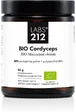
BIO Cordyceps sinensis / Organic Cordyceps sinensis extract powder
Organic Chinese Cordyceps
Organic Cordyceps extract , 2 scoops – 1 g daily. Just add to your coffee, tea, or smoothie and you’re good to go.
Organic certificate : product with a certificate of organic farming , certification body PL-EKO-02
Extract standardized to 30% polysaccharides
2 PLN DAILY PORTION
Pure composition: 100% cordyceps extract, no additives, carriers or fillers
Microbiologically tested for the presence of heavy metals, ethylene oxide and PESTICIDES
Quantity: 50 g/50 daily servings
Should be consumed before: 11/2028
Registered in GIS: BZ/SD/POW/PL1000D/015311/2026
Production certificates: GHP, GMP, HACCP, ISO 22000:2018, ISO 9001:2015
 Buried and manufactured in Poland
99,99 zł
498 in stock
Price per 100 g: PLN 199.98

 Free delivery within Poland from 250 zł
Previous lowest price was 99,99 zł.
Cordyceps sinensis – organic mycelium extract. DER 10:1, standardized to 30% polysaccharides.
PREMIERE


Dietary supplement
BIO Cordyceps sinensis / Organic Cordyceps sinensis extract powder
Organic Chinese Cordyceps
Organic Cordyceps extract , 2 scoops – 1 g daily. Just add to your coffee, tea, or smoothie and you’re good to go.
Organic certificate : product with a certificate of organic farming , certification body PL-EKO-02
Extract standardized to 30% polysaccharides
2 PLN DAILY PORTION
Pure composition: 100% cordyceps extract, no additives, carriers or fillers
Microbiologically tested for the presence of heavy metals, ethylene oxide and PESTICIDES
Quantity: 50 g/50 daily servings
Should be consumed before: 11/2028
Registered in GIS: BZ/SD/POW/PL1000D/015311/2026
Production certificates: GHP, GMP, HACCP, ISO 22000:2018, ISO 9001:2015
- Buried and manufactured in Poland
99,99 zł
498 in stock
Previous lowest price was 99,99 zł.
Price per 100 g: PLN 199.98
Free delivery from 250 zł
Shipping in 24h
Safe shopping guarantee
You will receive your product or your money back. Protection is provided by Trusted Shops.
See details
The BIO Cordyceps dietary supplement is a powdered preparation containing organic cordyceps sinensis .
Cordyceps sinensis is a mushroom native to the high-altitude meadows of the Tibetan Plateau and the Himalayas. In spring, a dark, club-shaped fruiting body emerges, hence the Tibetan name yartsa gunbu, meaning “worm in winter, grass in summer.”
In traditional Chinese and Tibetan medicine, it was used as a tonic for fatigue, weakness, lung and kidney problems, and to boost libido. Wild-harvested cordyceps is among the most expensive natural resources in the world.
Organic farming The raw material comes from certified organic farms. This certification means that the mushrooms are grown without synthetic pesticides or fertilizers, and the entire production chain is subject to monitoring by a certifying body.
The extract is standardized to 30% polysaccharides . Each batch contains a consistent amount of polysaccharides. Additionally, we test its beta-glucan content, as the “polysaccharide” content itself may also include starch and other complex sugars.
The powder can be added to your morning coffee, tea, smoothie, or oatmeal. This is the easiest way to make this herbal remedy part of your daily routine.
| INGREDIENT NAME | In a daily dose 2 scoops |
| Organic extract from the mycelium of Cordyceps sinensis , DER 10:1, standardized to 30% polysaccharides, | 1000 mg |
| including polysaccharides | 300 mg |
*NRV – Reference Intake Value for an Adult
Ingredients: organic extract from the mycelium of cordyceps sinensis (contains sulphites).
Gluten-free product.
Net weight: 50 g.
Portion recommended for consumption during the day : 1000 mg (equivalent to 2 scoops included in the package).
Recommended use : Dissolve the product in a glass of water, coffee, hot chocolate, or other beverage. May be added to cocktails, desserts, liquids, and semi-liquids at room temperature.
Do not exceed the recommended daily dose. To maintain good health, a varied diet and a healthy lifestyle are recommended. This dietary supplement should not be used as a substitute for a varied diet. This product is intended for adults.
Warning: Pregnant and breastfeeding women should consult a doctor before using the product.
Organoleptic properties: powder with a slightly earthy, nutty flavor, easily soluble
Storage: BIO Cordyceps dietary supplement should be stored in a place protected from sunlight, at a temperature of 15-25 ° C, in the original packaging, out of reach of small children.
Production batch number/ Best before end – information can be found on the individual label (left side of the label).
Batch tests performed:
- microbiology, presence of: listeria, staphylococcus, escherichia coli and coliforms, salmonella , mold, yeast, total number of microorganisms,
- presence of: echimidine and heliosupine, erucifolin, europine, heliotrin, intermedina, jacobin, lasjocarpine, licopsamine and indicine, monocrotaline, echimidine N-oxide, erucifolin N-oxide, europine N-oxide, heliosupine N-oxide, heliothrin N-oxide, Intermedin N-oxide, Indicin N-oxide, Echinatin N-oxide, Rinderin N-oxide, Jacobin N-oxide, Lasiocarpine N-oxide, Lycopsamine N-oxide, Moncrotaline N-oxide, Retrorzyne N-oxide, Usaramine N-oxide, Senecionine N-oxide, N-oxide integerrimine, senecyvernine N-oxide, seneciphylline N-oxide, sparthioidine N-oxide, retrorzyne, usaramine, rinderine and echinatin, seneciphylline, sparthioidine, senecyvernine, integerrimine, senecionine, senkirkine, trichodesmin, atropine, scopolamine,
- presence of pyrrolizidine and tropane alkaloids,
- heavy metals (arsenic, cadmium, lead, mercury),
- pesticides,
- ethylene oxide and 2-chloroethanol,
- gluten content.
The research was carried out in an independent, accredited GBA Poland Laboratory – Accreditation Certificate No. AB 1095 and in Institute of Horticulture of the National Research Institute – Accreditation Certificate No. AB 757.



Chinese cordyceps (Cordyceps sinensis)
Cordyceps sinensis is a fungus in the phylum Ascomycota, order Hypocreales, and family Ophiocordycipitaceae. For a long time, it was named Cordyceps sinensis , but in 2007, following molecular studies, it was transferred to the genus Ophiocordyceps . In China, it is known as dōng chóng xià cǎo , meaning “worm in winter, grass in summer.” The name aptly captures the mushroom’s unusual life cycle. Tibetans call it yartsa gunbu .
The species grows exclusively in the harsh high-altitude climates of the Tibetan Plateau and Himalayas, typically at altitudes of about 3,000 to 5,000 meters above sea level. It is found in the Chinese provinces of Tibet, Qinghai, Sichuan, Yunnan, and Gansu, as well as in Nepal, Bhutan, and northern India.
The cordyceps mushroom consists of two distinct parts: a yellowish-brown “caterpillar” and a dark, stem-like fruiting body. It is harvested by hand in May and June and is a major source of income for many Tibetan and Himalayan communities.
Wild cordyceps is one of the most expensive natural resources in the world. Prices for the best specimens reach tens of thousands of dollars per kilogram. Demand has led to heavy exploitation of natural habitats, and the International Union for Conservation of Nature has declared the species vulnerable to extinction. The mushroom is practically impossible to cultivate on a commercial scale, and its high price encourages counterfeiting, for example, by weighting specimens with metal elements to increase their weight.
Another popular substitute is the related cordyceps militaris , which is easy to cultivate and contains significantly more cordycepin than O. sinensis .
The chemical composition of cordyceps is complex . The most important are the nucleosides: adenosine, guanosine, uridine, and cordycepin (3′-deoxyadenosine), which is relatively low in cordyceps. An important group consists of polysaccharides, including β-glucans and galactomannans, which are believed to have immunomodulatory effects. The mushroom also contains D-mannitol, formerly called “cordycepic acid,” sterols, primarily ergosterol, cyclic peptides, amino acids, B vitamins, and trace elements such as zinc and selenium.
In traditional Chinese and Tibetan medicine, cordyceps has been considered a tonic for centuries, supporting the energetic “kidneys” and the lungs. It has been used for chronic fatigue and weakness, during convalescence, for coughs and shortness of breath, and for reduced libido.
Cordyceps without secrets
The name “cordyceps” combines the Greek word kordyle, meaning “club,” with the Latin -ceps, meaning “head.” It describes the characteristic shape of the fruiting body: elongated, ending in a club-like protuberance—hence the Polish name “maczużnik.” In China, this mushroom has for centuries been called dōng chóng xià cǎo, meaning “worm in winter, grass in summer.” The name refers to its unusual life cycle: it develops underground in winter, and in spring, it emerges above the surface like a blade of grass.
For centuries, cordyceps has been one of the most important and popular ingredients in traditional Chinese and Tibetan medicine. Traditionally, it was used as a tonic, especially during periods of increased exertion and fatigue. It contains, among other things, nucleosides (adenosine, cordycepin), polysaccharides (including beta-glucans), D-mannitol, sterols, and trace elements. The properties of this mushroom are still the subject of scientific research.
Cordyceps militaris and sinensis are related mushroom species. Cordyceps sinensis grows wild in the Himalayas and on the Tibetan Plateau. It is very rare and is one of the most expensive natural resources in the world. Cordyceps militaris is found in many regions of the world, including Europe, and can be cultivated. The two species differ in their composition: C. militaris contains significantly more cordycepin, while C. sinensis is dominated by other nucleosides, such as adenosine.
Cordyceps is a mushroom and naturally contains no caffeine or other methylxanthines, such as those found in coffee, tea, or guarana. Therefore, it can be incorporated into a daily diet, regardless of whether someone is limiting their caffeine intake.
There are no strict rules regarding when to take cordyceps. It’s most often recommended to take cordyceps in the morning or during the day, with a meal, which facilitates regular intake and is gentle on the digestive system. The most important thing is to take it regularly and in accordance with the recommended daily dose listed on the packaging.

Compose your treatment with LABS212®


Discover other LABS212® products
-

Dietary supplement
Magnesium L-Threonate Magtein®
Support for memory and concentration, increased energy levels. The only patented form of magnesium on the market that effectively crosses the blood-brain barrierMore -

Dietary supplement
Bromelain
Support for digestion and relief of digestive discomfort. High enzymatic activity: 1200 GDUMore -

Dietary supplement
FeroMax®
Support in the proper production of red blood cells and hemoglobin. Support in anemia, iron and ferritin deficiency.More -

Dietary supplement
Zinc Complex Capsule
A blend of 3 organic forms of zinc: picolinate, citrate, gluconate. Helps maintain normal immune system function.More